Model Context Protocol (MCP): How It Connects AI Agents with Tools and Data
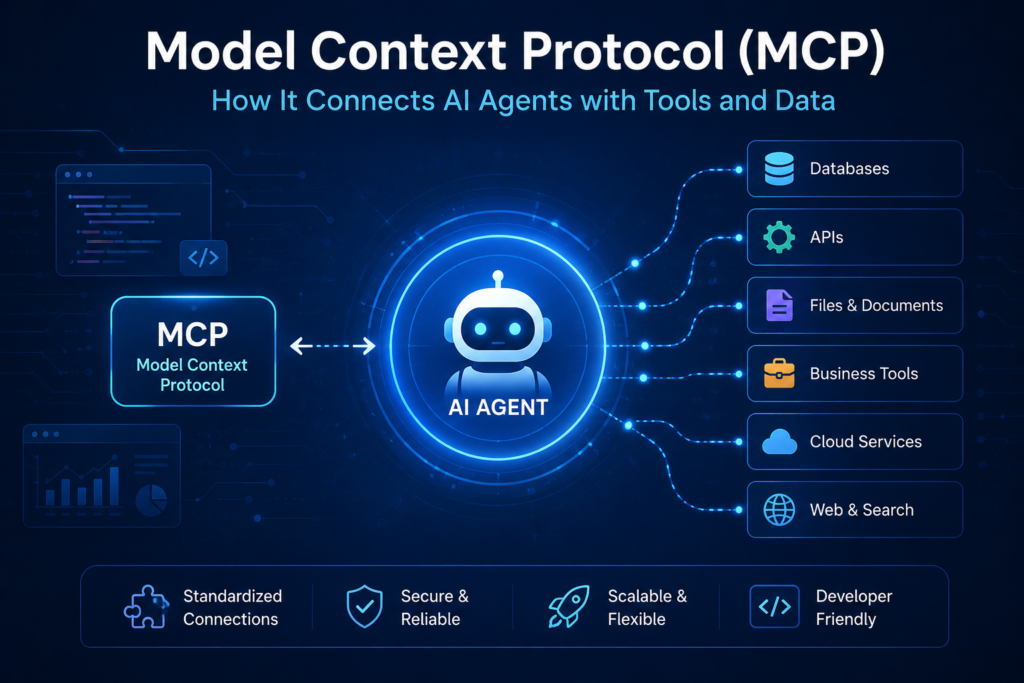
Model Context Protocol (MCP): How It Connects AI Agents with Tools and Data
Artificial Intelligence is moving beyond simple chatbots. Today, AI agents can answer questions, analyze information, perform tasks, and interact with external systems. But for an AI agent to become truly useful, it needs access to the right tools and data.
This is where the Model Context Protocol, or MCP, becomes important.
MCP provides a standard way for AI applications to connect with external tools, APIs, databases, files, and business systems. Instead of building a different custom connection for every tool, developers can use MCP to create a more organized and flexible connection between AI models and external resources.
What Is Model Context Protocol?
Model Context Protocol is an open standard designed to help AI systems communicate with external data sources and tools.
You can think of MCP like a common connection layer between an AI model and the systems it needs to use.
For example, an AI assistant may need to access:
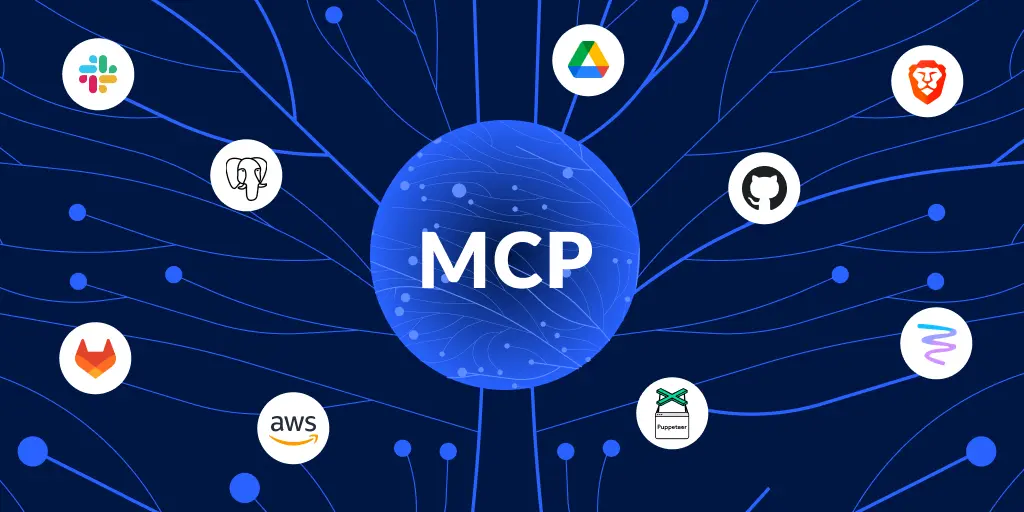
- Company databases
- Google Drive files
- CRM systems
- Internal APIs
- GitHub repositories
- Customer support platforms
- Business applications
- Analytics tools
Without a standard approach, developers often need to create separate integrations for each platform.
MCP makes this process easier by creating a common structure for connecting AI applications with different tools and data sources.
Why Do AI Agents Need MCP?
Traditional AI models mainly work with the information included in their training data or provided directly in a prompt.
Modern AI agents need much more.
Imagine asking an AI assistant:
“Check the latest customer orders and tell me which orders are delayed.”
The AI model cannot answer this correctly unless it can access the company’s current order database.
Another example could be:
“Find the latest project files, summarize the changes, and create a task for the development team.”
To complete this request, the AI agent may need access to file storage, project management software, and other business tools.
MCP helps AI agents securely connect to these systems so they can access useful context and perform real-world tasks.
How Does MCP Work?
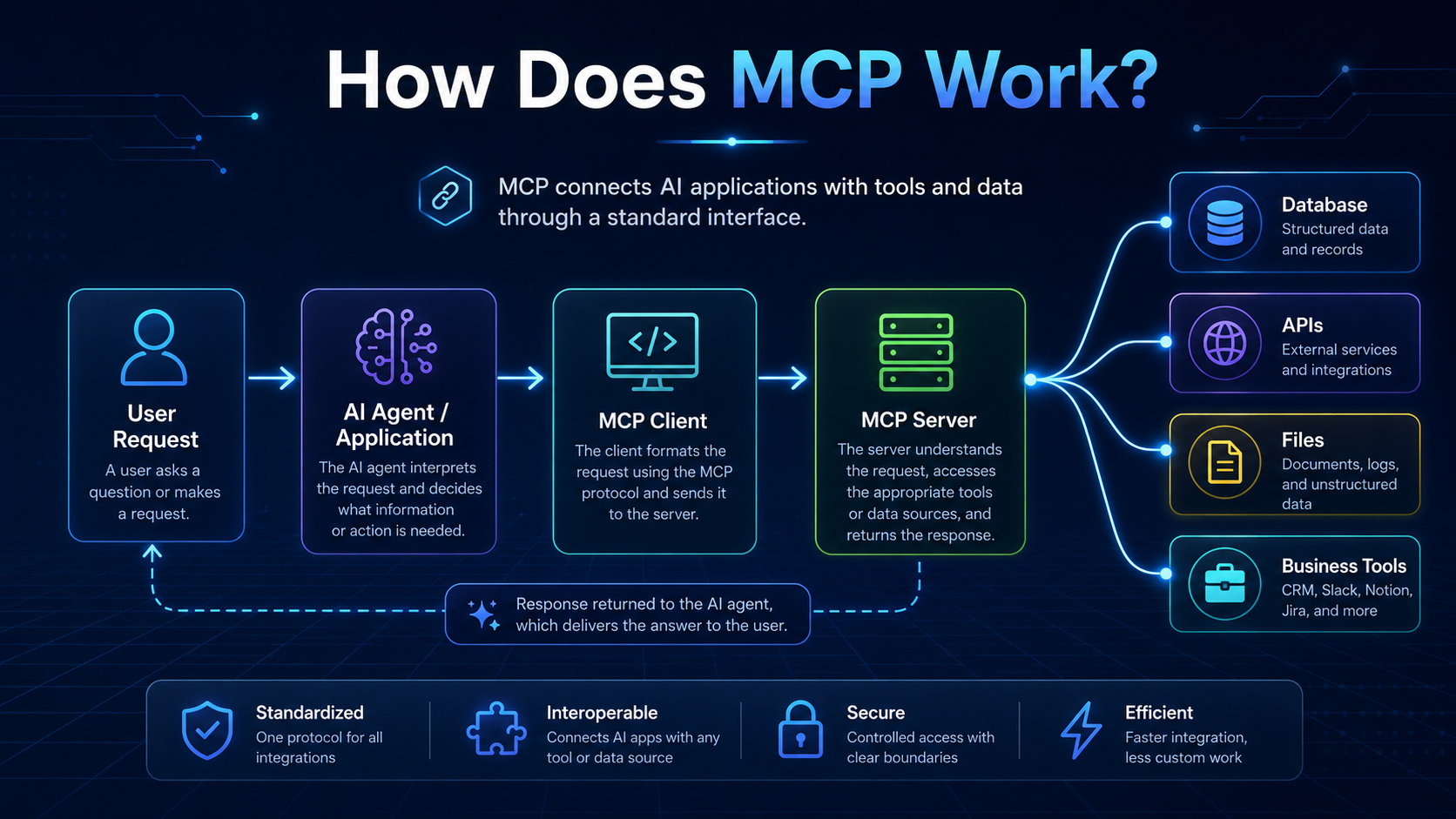
MCP usually works through three main parts: the AI application, the MCP client, and the MCP server.
The AI application could be an AI assistant, coding agent, enterprise chatbot, or another AI-powered system.
The MCP client manages the communication between the AI application and available MCP servers.
The MCP server connects the AI system to a specific tool, service, or data source.
For example:
AI Agent → MCP Client → MCP Server → Database or External Tool
The AI agent first understands what the user wants. It then identifies which tool or data source is needed. Through MCP, it communicates with the correct server, retrieves the required information, and uses that information to complete the task.
This structure makes AI integrations easier to manage and reuse.
MCP and AI Agents
AI agents are designed to do more than generate text. They can understand goals, decide what actions to take, use tools, and complete multi-step tasks.
MCP can make these agents much more capable.
Consider a sales AI agent.
A user might ask:
“Show me the customers who have not responded to our latest proposal and prepare follow-up messages.”
The AI agent may need to:
- Access the CRM.
- Find the correct customers.
- Review previous conversations.
- Identify customers who have not replied.
- Prepare personalized follow-up messages.
With MCP, the AI agent can connect to the required systems through standardized interfaces instead of relying on many separate custom integrations.
MCP vs Traditional API Integration
APIs are still extremely important. MCP does not replace APIs.
Instead, MCP can provide a standard way for AI applications to discover and use tools that may already be powered by APIs.
In a traditional setup, developers may need to manually define how an AI application communicates with every API.
When the number of tools increases, maintaining these integrations can become difficult.
MCP provides a more consistent structure.
This means developers can focus more on what the AI agent should accomplish instead of repeatedly building basic connection logic.
APIs provide access to services, while MCP helps AI systems interact with those services in a more standardized way.

MCP and RAG
MCP can also work well with Retrieval-Augmented Generation, commonly known as RAG.
RAG helps AI models retrieve useful information before generating an answer.
For example, a company chatbot may search internal documents before responding to an employee.
MCP can make it easier for the AI application to connect with different information sources such as document systems, databases, and search tools.
A RAG system might retrieve information from one source, while an AI agent might use MCP to access several tools depending on what the user asks.
When MCP and RAG are combined, AI systems can become more connected, context-aware, and useful for business applications.
Benefits of Model Context Protocol
One of the biggest advantages of MCP is simpler integration.
Developers can create reusable connections instead of building everything from scratch for each AI application.
MCP can also support better scalability. As businesses add more tools and data sources, the same communication structure can help manage those connections.
Another important benefit is flexibility.
Organizations can connect AI applications to internal systems while keeping control over which tools and information are available.
Some key benefits include:
- Standardized AI tool connections
- Easier integration with multiple systems
- Better support for AI agents
- Reusable connectors
- Improved developer experience
- Easier expansion of AI applications
- Better access to real-time business information
Real-World Use Cases of MCP
MCP can be useful across many industries and business functions.
Software Development
AI coding agents can connect with code repositories, documentation, issue trackers, and development tools.
An agent could review a GitHub issue, inspect related code, and suggest possible changes.
Customer Support
AI assistants can connect with customer databases, previous support conversations, and knowledge bases.
This allows them to provide responses based on the customer’s actual history.
Data Analysis
An AI agent can connect with databases and analytics systems to retrieve current information and generate summaries.
For example, a manager could ask:
“Compare this month’s sales with last month and explain the biggest changes.”
Enterprise Knowledge Management
Organizations often store information across many platforms.
MCP can help AI systems access these different sources through a more consistent integration approach.
Workflow Automation
AI agents can connect with multiple business tools to complete tasks automatically.
For example, an agent could analyze an email, retrieve customer details, update a CRM record, and create a follow-up task.
MCP and the Future of AI
The future of AI is not only about building smarter models.
It is also about helping those models interact safely and effectively with the systems people already use.
AI agents become much more valuable when they can access the right information at the right time and perform useful actions.
This makes interoperability increasingly important.
MCP has the potential to become an important building block for creating connected AI ecosystems where models, tools, applications, and data sources can work together more easily.
As AI agents continue to grow, standards like MCP may play an important role in simplifying how developers build these systems.
Final Thoughts
Model Context Protocol represents an important step toward more connected and capable AI applications.
Instead of keeping AI models isolated, MCP gives developers a standard way to connect them with tools, APIs, databases, files, and other systems.
For businesses, this can mean faster AI development, easier integrations, and more useful AI agents.
For developers, it can reduce the complexity of connecting multiple systems and make AI applications easier to expand.
The real power of AI agents comes from combining intelligence with access to the right tools and data, and MCP helps create the bridge between them.
As organizations move from simple chatbots toward intelligent AI agents, Model Context Protocol is a technology worth understanding and watching closely.
Comments
No comments yet. Be the first to comment.