AI-Powered Online Threats

The Internet Is Getting Smarter — But So Are Hackers
Artificial Intelligence is making life easier. It helps people write content, generate images, automate work, build apps, analyze data, and improve productivity.
But there is another side of AI.
Cybercriminals are also using AI.
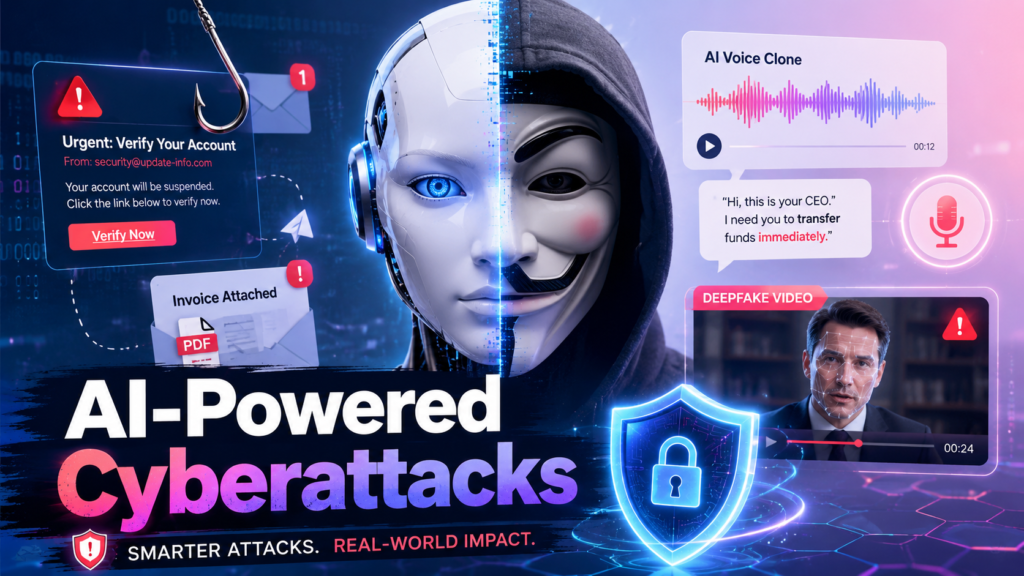
Today, hackers can use AI tools to create realistic scam emails, fake videos, cloned voices, automated malware, and personalized attacks that are harder to detect.
This is why AI-powered cyberattacks have become one of the most important cybersecurity topics right now. Google Cloud’s 2026 cybersecurity forecast warns that attackers will use AI to increase the speed, scale, and effectiveness of cyberattacks, while defenders will also use AI agents to improve security operations.
What Are AI-Powered Cyberattacks?
AI-powered cyberattacks are cyber threats where attackers use artificial intelligence to plan, create, automate, or improve their attacks.
Instead of manually writing every scam message or testing every password, attackers can use AI to work faster.
Simple Example
A normal phishing email may look fake.
But an AI-generated phishing email can:
- Use perfect grammar
- Copy a company’s writing style
- Mention your job role
- Create urgency
- Look professional
- Avoid obvious spelling mistakes
- Sound like a real manager, bank, or support team
That makes it much more dangerous.
Why AI Cyberattacks Are Catching Everyone’s Attention
1. Phishing Emails Look More Real
Phishing is one of the most common cyberattacks.
Earlier, scam emails were easier to identify because they often had spelling mistakes, strange formatting, or suspicious language.
Now AI can generate clean, professional, and personalized messages.
Example
A fake email may say:
“Your salary document is ready. Please login to verify your company account.”
If the email looks like it came from your HR department, many users may click without thinking.
2. Deepfake Scams Are Becoming More Dangerous
AI can now generate fake voices, fake faces, and fake videos.
This creates a new type of fraud.
Attackers can pretend to be:
- Company CEOs
- Family members
- Bank employees
- Customer support agents
- Government officers
- Business partners
Deepfake scams are especially dangerous because humans naturally trust familiar voices and faces.
A recent academic survey on AI-driven cybersecurity threats identifies deepfakes, synthetic media, automated malware, adversarial AI, and AI-powered social engineering as major emerging risks.
3. Malware Can Become More Automated
Malware is harmful software designed to damage systems, steal data, or control devices.
With AI, attackers may improve malware by making it:
- Faster
- More adaptive
- Better at avoiding detection
- More targeted
- Easier to modify
- More automated
This does not mean every hacker has super-powerful AI malware, but the trend is clear: cyberattacks are becoming more automated and intelligent.
4. AI Can Help Attackers Find Weaknesses Faster
Hackers often look for weak points in websites, apps, servers, and cloud systems.
AI can help them analyze large amounts of information quickly.
Attackers may use AI to:
- Scan websites
- Find exposed data
- Test weak passwords
- Create fake login pages
- Generate malicious code
- Write convincing scam messages
- Research victims online
This means cybersecurity teams must also become faster.
How AI Is Helping Defenders Too
The good news is that AI is not only helping attackers.
Security teams are also using AI to detect and stop threats.
AI can help cybersecurity teams:
- Detect unusual login behavior
- Analyze suspicious files
- Find malware patterns
- Monitor network traffic
- Detect phishing emails
- Prioritize security alerts
- Respond faster to attacks
- Identify risky user behavior
Research on AI in cybersecurity highlights areas like intrusion detection, malware analysis, phishing detection, privacy-preserving learning, and explainable AI as major current directions.
Real-Life Areas Where AI Security Matters
Banking
AI can help detect fraud, but attackers can also use AI to create fake identity documents or scam messages.
Social Media
Fake profiles, deepfake videos, and AI-generated misinformation can spread quickly.
Business
Employees may receive realistic fake emails asking for payments, passwords, or confidential files.
Education
Students and institutions may face fake login pages, data theft, and account hijacking.
Healthcare
Hospitals and clinics store sensitive patient data, making them attractive targets.
E-Commerce
Fake customer support, payment scams, and account takeover attacks can affect online shoppers.
Warning Signs of an AI-Powered Scam
Look carefully if you notice:
Unexpected urgent message
Request for password or OTP
Suspicious payment request
Unknown file attachment
Fake login link
Message from a familiar person but unusual tone
Too-good-to-be-true offer
Voice call asking for money urgently
Email address that looks slightly different
Do not trust a message only because it sounds professional.
How Normal Users Can Stay Safe
Use Strong Passwords
Avoid simple passwords like your name, birthday, phone number, or “123456”.
Use long and unique passwords for important accounts.
Enable Two-Factor Authentication
Two-factor authentication adds another layer of protection.
Even if someone gets your password, they still need another verification step.
Do Not Click Suspicious Links
Before clicking a link, check:
- Who sent it
- Whether the domain is correct
- Whether the message feels urgent or strange
- Whether it asks for private information
Verify Through Another Channel
If someone asks for money, passwords, or sensitive files, verify through another trusted method.
For example, call the person directly instead of replying to the suspicious message.
Keep Devices Updated
Software updates often fix security weaknesses.
Update your phone, laptop, browser, apps, and antivirus software regularly.
How Businesses Can Protect Themselves
Businesses should take AI cyber threats seriously.
Important steps include:
- Employee security training
- Phishing simulations
- Strong access control
- Zero-trust security
- Endpoint protection
- Email security tools
- Cloud security monitoring
- AI-based threat detection
- Incident response planning
- Regular backups
Security should not depend only on tools. People, processes, and awareness are equally important.
The Future of AI and Cybersecurity
AI will continue to change cybersecurity.
In the future, we may see:
- More realistic phishing attacks
- More deepfake scams
- More automated hacking attempts
- AI security agents helping defenders
- Stronger identity verification
- Passwordless login adoption
- Better fraud detection
- More regulations around AI misuse
The battle will not be humans vs machines.
It will be attackers using AI vs defenders using AI.
Final Thoughts
AI-powered cyberattacks are one of the most important digital threats today.
The scary part is that these attacks can look normal, professional, and believable.
But users can stay safe by being careful, verifying messages, using strong security habits, and staying aware of new scams.
In the AI age, cybersecurity is not only about protecting devices. It is about protecting trust.

Comments
No comments yet. Be the first to comment.