AI in 2026: Latest Updates, Trends, and What’s New in Artificial Intelligence
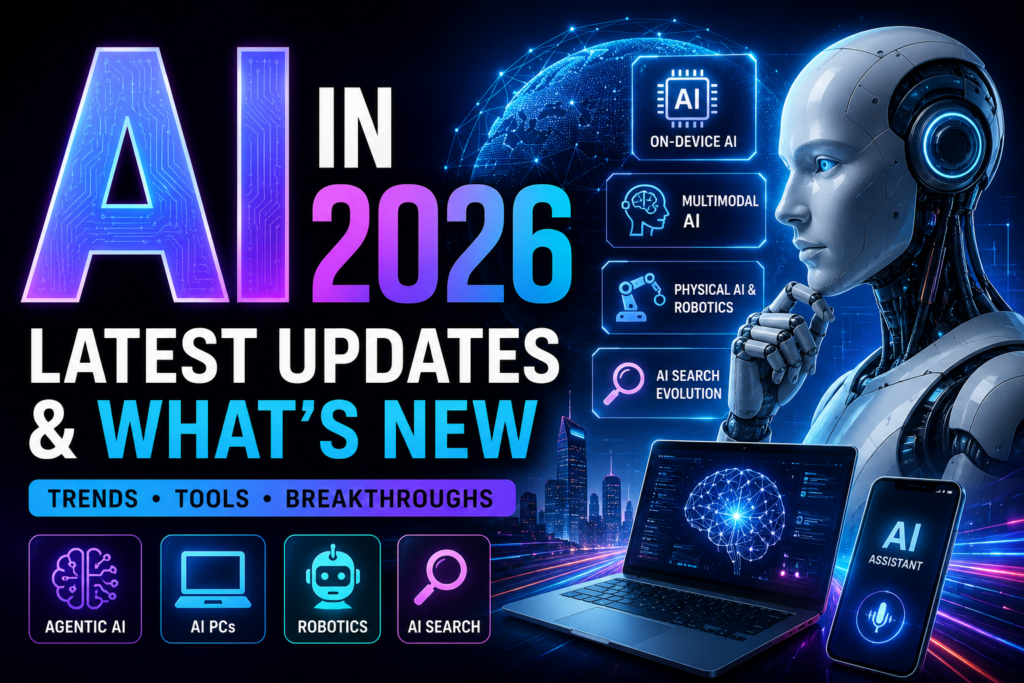
Artificial Intelligence in 2026 is no longer just about chatbots answering questions. AI is now moving into a new phase where systems can reason, plan, use tools, generate multimedia content, assist with software development, run on personal devices, and help automate real business workflows.
One of the biggest changes in 2026 is the shift from simple generative AI to agentic AI. Instead of only responding to a prompt, AI agents can break a task into steps, use tools, search information, write code, summarize results, and help complete complex work with less manual input.
1. Agentic AI Is Becoming the Biggest AI Trend
Agentic AI is one of the most important AI updates in 2026. These systems are designed to act more like digital workers or smart assistants. They can plan tasks, make decisions within limits, use connected tools, and complete multi-step workflows.
For example, an AI agent can help with:
- Researching a topic
- Writing a report
- Creating a project plan
- Reviewing code
- Testing software
- Managing customer support tasks
- Summarizing business data
- Automating repetitive office work
McKinsey’s latest AI research shows strong business interest in AI agents, with many organizations experimenting with them, although many are still working out how to scale them safely and effectively.
2. AI PCs and On-Device AI Are Growing Fast
Another major update in 2026 is the rise of AI-powered personal computers. Instead of depending only on cloud servers, more AI tasks are moving directly onto laptops and desktops.
Nvidia announced RTX Spark, a new AI-focused chip designed to bring AI agent capabilities directly to personal computers. The chip is expected to power AI features locally on laptops and desktops from major manufacturers such as Dell, HP, Lenovo, ASUS, and MSI.
This matters because on-device AI can offer:
- Faster AI responses
- Better privacy
- Lower cloud dependency
- Offline AI features
- Personalized local assistants
- Better performance for creators and developers
AI PCs may change how people use computers. Instead of only clicking through apps manually, users may rely more on AI agents that can help navigate files, summarize documents, automate tasks, and assist with creative work.
3. Multimodal AI Is Becoming More Advanced
In 2026, AI is becoming more multimodal. That means modern AI systems can understand and work with different types of content together, such as:
- Text
- Images
- Audio
- Video
- Code
- Documents
- Charts and screenshots
This makes AI more useful for real-world tasks. For example, a user can upload a chart and ask for an explanation, provide a screenshot and ask for troubleshooting, generate image ideas from text, or analyze long documents with tables and visuals.
Multimodal AI is especially useful in education, healthcare, design, customer support, software development, and business reporting.
4. Physical AI and Robotics Are Getting More Attention
One of the most exciting AI updates in 2026 is the growth of physical AI. This means AI systems are being built not only to understand text and images, but also to understand and predict the physical world.
Nvidia announced Cosmos 3, an open AI world model designed for robots, autonomous vehicles, and physical systems. It was trained on large amounts of multimodal data, including images, videos, audio, text, and action data, to help machines better understand real-world environments.
This trend could improve:
- Robotics
- Self-driving systems
- Industrial automation
- Smart factories
- Simulation training
- Autonomous machines
- AI-powered physical assistants
Physical AI may become one of the most important areas of AI development because it connects digital intelligence with real-world movement and decision-making.
5. AI Search Is Changing How People Find Information
AI search is another major development. Traditional search engines mostly showed links, but AI search can summarize answers directly, compare information, and help users understand topics faster.
Research on AI search found that AI-generated search results expanded rapidly in recent years, changing how people access information online. The study also raised concerns about source diversity, credibility, and how AI search may affect publishers and human judgment.
For blog websites, this is very important. Content creators now need to focus on:
- Clear explanations
- Helpful original content
- Strong topic authority
- Updated information
- Structured headings
- Trustworthy sources
- Human-readable writing
AI search may reduce simple traffic for basic answers, but high-quality content can still perform well when it provides depth, examples, and real value.
6. AI in Software Development Is Becoming More Powerful
AI coding assistants are becoming more advanced in 2026. Developers now use AI to write code, explain errors, generate tests, review pull requests, and create documentation.
However, companies are still careful about fully autonomous coding. A 2026 study on agentic AI in industry found that many companies are experimenting with AI assistants and agents, but production adoption is limited by challenges such as verification, data confidentiality, non-deterministic outputs, and difficulty working with proprietary systems.
This means AI can speed up software development, but human developers are still important for:
- Reviewing code quality
- Checking security
- Testing outputs
- Understanding business logic
- Managing architecture
- Making final decisions
7. AI Governance, Safety, and Regulation Are More Important Than Ever
As AI becomes more powerful, safety and regulation are becoming major priorities. Businesses and governments are paying more attention to responsible AI because mistakes can affect privacy, fairness, jobs, security, and public trust.
Important AI governance topics in 2026 include:
- Data privacy
- Model transparency
- Bias reduction
- Copyright concerns
- Deepfake detection
- Secure AI deployment
- Human review systems
- Responsible automation
Stanford’s 2026 AI Index highlights that AI capabilities are advancing quickly, while the ability to measure, manage, and govern AI is still catching up.
8. AI Adoption Is Increasing Across Industries
AI is being used across many industries, including:
- Healthcare
- Education
- Finance
- E-commerce
- Cybersecurity
- Manufacturing
- Marketing
- Software development
- Customer support
- Media and entertainment
Businesses are not only using AI for experimentation anymore. Many are trying to connect AI directly to productivity, cost savings, customer experience, and better decision-making.
9. What’s New in AI in 2026?
Here are the biggest AI updates and trends to remember:
- Agentic AI: AI systems that can plan and complete multi-step tasks
- AI PCs: More AI running locally on laptops and desktops
- Multimodal AI: AI that understands text, images, audio, video, and code
- Physical AI: AI for robotics, autonomous vehicles, and real-world systems
- AI search: Search engines giving direct AI-generated answers
- AI coding tools: Better support for developers and software teams
- AI governance: Stronger focus on safety, privacy, and regulation
- Enterprise AI: More businesses using AI in real workflows
- Edge AI: AI running closer to users and devices instead of only in the cloud
- Synthetic data: Artificially generated data used for training and testing AI systems
Conclusion
AI in 2026 is becoming more powerful, practical, and deeply connected to daily life. The biggest shift is from AI as a simple content generator to AI as an active assistant that can understand context, use tools, automate workflows, and support real-world decisions.
For users, this means smarter apps, better search, more personalized devices, and faster productivity tools. For businesses, it means new opportunities to automate work, improve services, and build intelligent products.
The future of AI will not only depend on better models. It will also depend on how responsibly people use them. The best results will come from combining AI speed and automation with human creativity, judgment, and ethics.

Comments
No comments yet. Be the first to comment.