🛑 The Day Windows Crashed
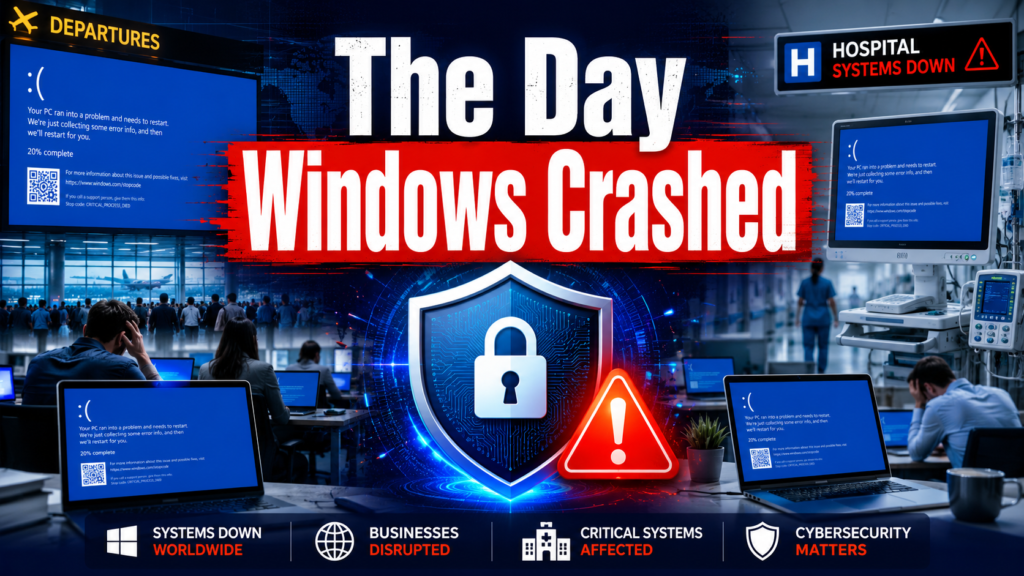
🚨 A Normal Update That Shocked the World
On July 19, 2024, many businesses around the world faced a sudden technology crisis.
Airports were delayed.
Banks faced system issues.
Hospitals were disrupted.
Offices could not work normally.
Windows computers started showing blue screen errors.
At first, many people thought it was a cyberattack.
But it was not.
It was caused by a faulty update from CrowdStrike Falcon, a cybersecurity software used by many large organizations.
⚡ Quick Fact Box
Incident Type: Security software update failure
Affected System: Microsoft Windows devices
Company Involved: CrowdStrike
Main Impact: Blue Screen of Death errors
Cyberattack: No
Lesson: Security software must also be reliable
🧩 What Actually Happened?
CrowdStrike is a major cybersecurity company. Its Falcon software helps protect business computers from malware, hackers, and suspicious activity.
The issue began when CrowdStrike released a faulty update for Windows systems.
That update caused many Windows machines to crash and show the famous:
Blue Screen of Death
The affected computers were mostly business and enterprise systems, not regular personal home computers.
🌍 Why Did This Become a Global Problem?
The number of affected devices may seem small compared to all Windows computers in the world, but many of those systems belonged to important organizations.
That is why the outage disrupted:
- ✈️ Airlines
- 🏦 Banks
- 🏥 Hospitals
- 📰 Media companies
- 🛒 Retail businesses
- 🏢 Offices
- 🏛️ Government services
- 🎧 Customer support centers
When critical business computers fail at the same time, even a small technical issue can become a global disruption.
❓ Was It a Cyberattack?
No, it was not a cyberattack.
This was not ransomware.
This was not hacking.
This was not malware.
This was not a data breach.
It was a security software update failure.
But it still became a major cybersecurity lesson because it showed one important truth:
Security tools protect systems, but if they fail, they can also create massive disruption.
Cybersecurity is not only about stopping hackers. It is also about keeping systems stable, available, tested, and recoverable.
🔥 Why This Incident Caught Everyone’s Attention
1. It Involved Trusted Security Software
CrowdStrike is trusted by many large organizations.
So when a security tool caused computers to crash, it created confusion and concern.
People started asking:
- How can one update break so many systems?
- Were companies too dependent on one security tool?
- Should updates be tested more carefully?
- How can businesses recover faster next time?
2. It Showed How Connected the World Is
Modern businesses are deeply connected through software, cloud systems, networks, and security tools.
One bad update can affect many layers:
Security Software
↓
Windows Computers
↓
Business Systems
↓
Airlines, Banks, Hospitals, Offices
↓
Customers and Normal Users
This is why digital resilience is now more important than ever.
3. It Proved Recovery Plans Matter
Many organizations learned that having security software is not enough.
They also need strong recovery planning.
A business should always ask:
If our systems fail today, how quickly can we recover?
🛡️ Business Lessons from the CrowdStrike Outage
Lesson 1: Test Updates Before Full Rollout
Software updates should never be pushed everywhere at once without testing.
A safer rollout looks like this:
Test Group
 ↓
Small Department
↓
Regional Rollout
↓
Full Company Deployment
This helps detect problems before they affect the entire organization.
Lesson 2: Do Not Depend on One Security Layer
Security should work in layers.
A strong cybersecurity system may include:
- Endpoint protection
- Network monitoring
- Cloud security
- Identity protection
- Email security
- Backup systems
- Access control
- Incident response planning
If one layer fails, other layers should reduce the damage.
Lesson 3: Keep Recovery Instructions Ready
During a crisis, IT teams do not have time to search randomly for solutions.
They need clear recovery instructions.
A strong recovery plan should include:
Who will respond?
Which systems are most critical?
How will teams communicate?
How will affected devices be restored?
How will customers be updated?
How will services continue?
How will progress be reported?
Lesson 4: Cybersecurity Also Means Availability
Most people think cybersecurity only means stopping hackers.
But cybersecurity has three important parts:
| Security Principle | Meaning |
|---|---|
| Confidentiality | Keep data private |
| Integrity | Keep data accurate |
| Availability | Keep systems usable |
The CrowdStrike outage mainly affected availability.
Systems were not hacked, but they became unusable.
That is why this incident became a major cybersecurity lesson.
👥 How Normal Users Experienced It
Many normal users did not know what CrowdStrike was.
They only saw the effects:
- Flights delayed
- Work laptops crashed
- Hospital systems slowed
- Store payments affected
- Online services disrupted
- Customer support unavailable
This showed that cybersecurity tools can affect everyday life, even for people who never directly use them.
✅ What Could Prevent Similar Incidents?
Safer Update Management
Updates should be tested in controlled environments before wide release.
Staged Rollouts
Companies should release updates slowly instead of pushing them everywhere at once.
Endpoint Recovery Tools
IT teams should have tools to quickly repair or restore affected devices.
Vendor Risk Management
Businesses should understand how much they depend on each software provider.
Better Monitoring
Early warning systems can detect unusual crashes before a problem spreads widely.
Business Continuity Planning
Organizations should prepare for both cyberattacks and technical failures.
📌 Why This Story Still Matters
The CrowdStrike outage became a global reminder that modern technology is powerful, but also fragile.
Security software protects businesses from threats, but it must also be:
- Safe
- Reliable
- Tested
- Recoverable
- Carefully managed
This incident changed how many companies think about software updates, cybersecurity vendors, IT resilience, risk management, disaster recovery, and critical infrastructure protection.
Final Thoughts
The CrowdStrike Windows outage was not a cyberattack, but it became one of the biggest security-related technology failures in recent history.
It showed that cybersecurity is not only about fighting hackers.
It is also about making sure systems stay reliable, recoverable, and safe during unexpected failures.
A secure system is not truly secure if one bad update can bring it down.

Comments
No comments yet. Be the first to comment.