Knowledge Graphs in AI
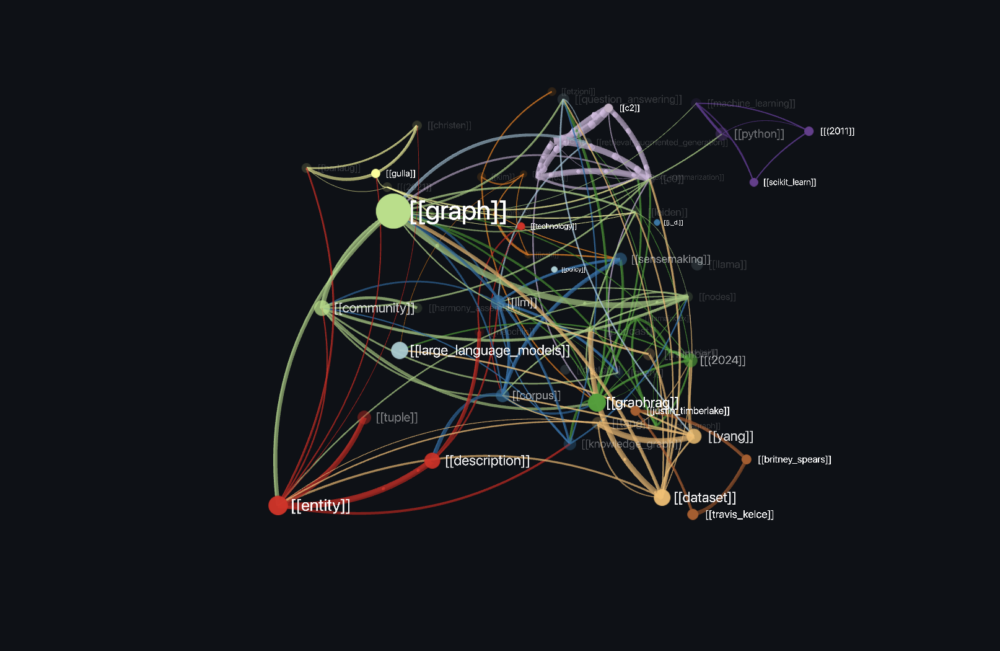
Ask most vector-based RAG systems a question that spans three documents and requires connecting the dots between them, and you’ll usually get one of two failures: a confidently wrong answer stitched together from loosely related chunks, or a shrug because no single chunk had enough context to answer fully.
That’s the exact gap knowledge graphs are stepping into — and it’s why “GraphRAG” has become one of the more consequential shifts in enterprise AI infrastructure over the last two years.
What a Knowledge Graph Actually Is
A knowledge graph represents information as entities and the relationships between them — not as isolated blobs of text. Instead of “Document A mentions Acme Corp” and “Document B mentions a supplier contract,” a knowledge graph explicitly encodes: Acme Corp —(supplies)→ Widget Co —(under contract)→ Q3 2026 Agreement —(has clause)→ Termination Rights.
That structure is the whole point. It lets a system answer questions that depend on connections, not just semantic similarity — the kind of multi-hop reasoning a plain vector search structurally can’t do, because a single chunk of text was never going to contain the full chain of relationships in the first place.
Why This Is Suddenly Everywhere: GraphRAG
The convergence of knowledge graphs with LLMs — commonly called GraphRAG — is the mechanism driving most of the current momentum. GraphRAG is a technique for richly understanding text datasets by combining text extraction, network analysis, and LLM prompting into a single end-to-end system, an approach Microsoft Research formalized and has continued to develop since releasing GraphRAG.
The core workflow: an LLM reads a document corpus, extracts entities and relationships, builds a graph out of them, and then at query time traverses that graph — following edges, aggregating connected context, sometimes summarizing whole clusters of related entities — before generating an answer. It’s retrieval that understands structure, not just wording.
Real deployments back this up. Legal departments are adopting GraphRAG to navigate contracts, case law, and regulatory documents, because a question like “what are our termination rights if a supplier misses quality standards across three consecutive quarters” requires connecting supplier performance, contract terms, and legal precedent — three separate concerns that live in three different places in the source documents.
Comments
No comments yet. Be the first to comment.