Backend Development in 2026: Latest Trends, Tools, and What Developers Should Know
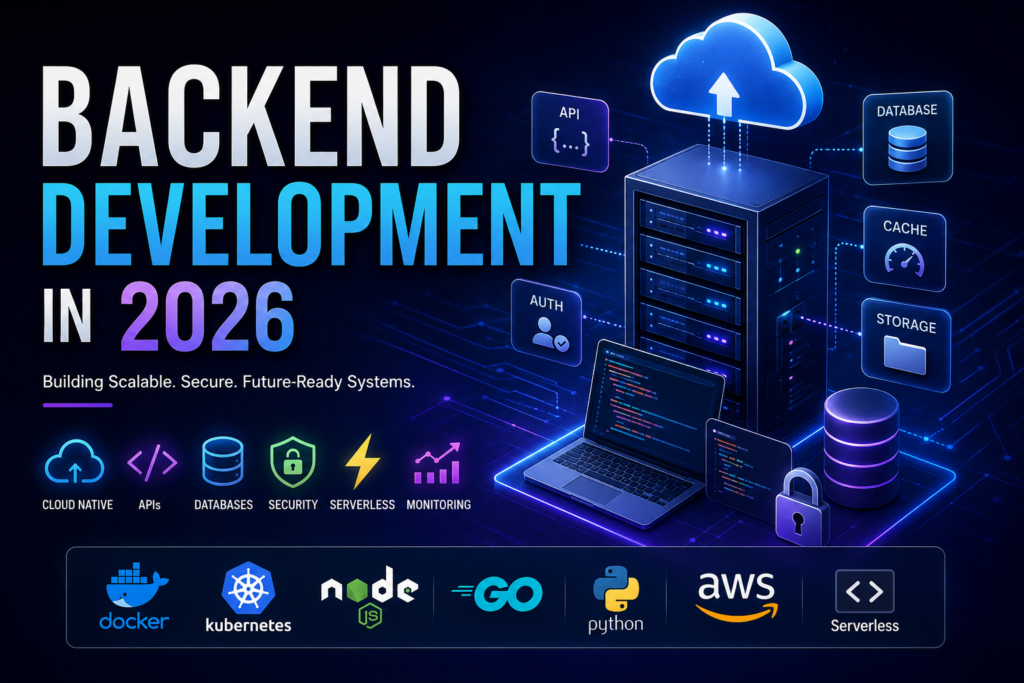
Backend development is no longer just about writing server-side code.
In 2026, backend developers are building intelligent, scalable, secure, and cloud-ready systems that power web apps, mobile apps, AI tools, SaaS platforms, and enterprise software.
The backend is the invisible engine of every digital product. It handles business logic, databases, APIs, authentication, payments, file storage, background jobs, security, and communication between different services.
But the backend world is changing quickly. New technologies like AI APIs, serverless platforms, edge computing, container orchestration, vector databases, event-driven systems, and modern runtimes are reshaping how developers build applications.
1. The Backend Is Becoming AI-Ready
One of the biggest backend trends in 2026 is the rise of AI-powered applications.
Today, many apps are adding AI features such as:
- AI chat assistants
- Smart search
- Recommendation systems
- Document summarization
- Code generation
- Image or video analysis
- Voice-based support
- Automated customer service
To support these features, backend systems now need to connect with AI models, vector databases, prompt pipelines, and secure data layers.
Example
A traditional backend may only return user data from a database.
An AI-ready backend may:
- Receive a user question
- Search related documents
- Send context to an AI model
- Generate a useful answer
- Store the conversation history
- Return the response securely
This means backend developers are now working with tools like:
- REST APIs
- GraphQL APIs
- Vector databases
- Embedding models
- AI orchestration tools
- Background processing queues
- Secure API gateways
2. Serverless Backend Is Growing
Serverless architecture is becoming more popular because developers can build and deploy backend functions without managing servers directly.
With serverless, developers can focus more on code and less on infrastructure.
Common serverless use cases
| Use Case | Example |
|---|---|
| Authentication | Login and signup functions |
| File processing | Resize uploaded images |
| Notifications | Send emails or SMS |
| APIs | Create lightweight backend endpoints |
| Automation | Run scheduled jobs |
| AI tasks | Process prompts or analyze data |
Popular serverless platforms include:
- AWS Lambda
- Google Cloud Functions
- Azure Functions
- Cloudflare Workers
- Vercel Functions
- Netlify Functions
Why serverless is useful
- Lower infrastructure management
- Automatic scaling
- Faster deployment
- Pay-as-you-use pricing
- Great for APIs and microservices
However, serverless is not perfect for every project. Developers still need to consider cold starts, vendor lock-in, debugging complexity, and cost at scale.
3. Edge Computing Is Making Backends Faster
Edge computing is another major backend trend.
In traditional backend systems, user requests travel to a central server. With edge computing, backend logic can run closer to the user.
This helps reduce latency and improve speed.
Where edge backend is useful
- Global websites
- Streaming platforms
- E-commerce apps
- Gaming apps
- Real-time dashboards
- AI personalization
- Security filtering
- Location-based services
For example, if a user in India visits a global website, edge computing can process some backend logic from a nearby server instead of sending every request to a faraway data center.
Benefits of edge backend
- Faster response time
- Better user experience
- Reduced server load
- Improved reliability
- Better support for global applications
In 2026, many high-performance apps are using a mix of cloud backend + edge functions.
4. Kubernetes and Cloud-Native Backend Are Still Important
Cloud-native development continues to grow because modern applications need scalability, reliability, and flexible deployment.
Kubernetes is widely used for managing containerized backend applications.
Why backend teams use Kubernetes
- Run applications in containers
- Scale services automatically
- Manage microservices
- Improve deployment reliability
- Support high-traffic systems
- Run AI and data workloads
- Manage infrastructure consistently
A cloud-native backend usually includes:
Application Code
       ↓
Docker Container
       ↓
Kubernetes Cluster
       ↓
Cloud Infrastructure
       ↓
Monitoring + Logging + Security
Kubernetes is powerful, but it can be complex. That is why many teams are also using managed Kubernetes services and platform engineering tools to simplify backend operations.
5. APIs Are Becoming More Secure and More Structured
APIs are the connection layer between frontend, mobile apps, backend services, databases, and third-party platforms.
In 2026, backend APIs need to be:
- Fast
- Secure
- Well-documented
- Scalable
- Easy to test
- Version-controlled
- AI-ready
Popular API styles
| API Type | Best For |
|---|---|
| REST API | Common web and mobile apps |
| GraphQL | Flexible data fetching |
| gRPC | High-performance service communication |
| WebSocket | Real-time communication |
| Webhook | Event-based integrations |
Security is now a major part of API development. Developers must protect APIs from unauthorized access, data leaks, abuse, and injection attacks.
Important API security practices
- Use HTTPS
- Validate all inputs
- Use authentication tokens
- Apply rate limiting
- Avoid exposing sensitive data
- Use role-based access control
- Monitor suspicious requests
- Keep API documentation updated
6. Backend Databases Are Becoming More Specialized
In the past, many apps used only one database. In 2026, backend systems often use different databases for different needs.
Common backend database stack
| Database Type | Example Use |
|---|---|
| SQL Database | Users, orders, payments |
| NoSQL Database | Flexible app data |
| Cache Database | Fast temporary data |
| Vector Database | AI search and embeddings |
| Search Engine | Full-text search |
| Time-Series Database | Logs, metrics, IoT data |
For example, a modern AI-powered app may use:
- PostgreSQL for user accounts
- Redis for caching
- MongoDB for flexible content
- Elasticsearch for search
- Pinecone, Weaviate, or pgvector for AI similarity search
This trend is making backend architecture more powerful but also more complex.
7. Real-Time Backend Features Are in Demand
Users now expect applications to update instantly.
Real-time backend systems are used in:
- Chat apps
- Live notifications
- Online gaming
- Trading dashboards
- Food delivery tracking
- Collaboration tools
- Live comments
- IoT monitoring
- Admin dashboards
Common technologies for real-time backend development include:
- WebSockets
- Server-Sent Events
- Message queues
- Pub/Sub systems
- Redis streams
- Kafka
- MQTT
Example
When a customer places an order, a real-time backend can instantly update:
- Customer app
- Restaurant dashboard
- Delivery partner app
- Admin panel
- Notification system
This creates a smoother and faster user experience.
8. Backend Security Is Now a Core Skill
Backend developers in 2026 must understand security from the beginning of development.
Security is no longer something added at the end.
Common backend security risks
- Weak authentication
- SQL injection
- Cross-site scripting
- Broken access control
- Exposed API keys
- Insecure file uploads
- Poor session management
- Missing rate limits
- Misconfigured cloud storage
Backend security checklist
[ ] Use environment variables for secrets
[ ] Never expose API keys in frontend code
[ ] Validate and sanitize user input
[ ] Use HTTPS everywhere
[ ] Encrypt sensitive data
[ ] Add rate limiting
[ ] Use secure authentication
[ ] Keep dependencies updated
[ ] Log important security events
[ ] Review permissions regularly
A secure backend protects both the business and the users.
9. Modern Backend Languages and Runtimes Are Evolving
Backend development is no longer limited to one or two popular technologies. Developers now choose tools based on performance, scalability, ecosystem, and project needs.
Popular backend technologies in 2026
| Technology | Why Developers Use It |
|---|---|
| Node.js | JavaScript backend, large ecosystem |
| Python | AI, APIs, automation, data-heavy apps |
| Go | Fast cloud-native services |
| Java | Enterprise backend systems |
| PHP | Web apps, CMS, Laravel, WordPress |
| Rust | Performance and memory safety |
| Bun | Fast JavaScript runtime and toolkit |
| Deno | Secure TypeScript runtime |
JavaScript and TypeScript backend development is also changing. Tools like Bun and Deno are pushing the ecosystem toward faster runtimes, better security, and simpler developer workflows.
10. Observability Is Essential for Backend Systems
As backend systems become more distributed, developers need better visibility into what is happening inside their applications.
Observability helps teams understand performance, errors, traffic, and system health.
Important observability tools
- Logs
- Metrics
- Traces
- Error tracking
- Uptime monitoring
- Performance dashboards
- Alerting systems
Backend developers should be able to answer questions like:
- Why is the API slow?
- Which service is failing?
- How many users are affected?
- Is the database overloaded?
- Did the latest deployment cause errors?
Popular observability tools include:
- Prometheus
- Grafana
- OpenTelemetry
- Datadog
- New Relic
- Sentry
- ELK Stack
Backend Developer Roadmap for 2026
Beginner Level
Learn the basics first:
- HTTP and HTTPS
- APIs
- Databases
- Authentication
- Server-side programming
- Git and GitHub
- Basic deployment
Intermediate Level
Build real-world backend skills:
- REST APIs
- SQL and NoSQL databases
- Caching
- File uploads
- Background jobs
- API security
- Testing
- Docker
Advanced Level
Learn modern backend architecture:
- Microservices
- Kubernetes
- Serverless
- Edge computing
- Message queues
- Observability
- CI/CD pipelines
- AI API integration
- Vector databases
- Cloud architecture
Quick Backend Architecture Example
User
 ↓
Frontend App
 ↓
API Gateway
 ↓
Authentication Service
 ↓
Backend Services
 ↓
Database + Cache + File Storage
 ↓
Monitoring + Logs + Security Layer
This type of structure helps applications stay scalable, secure, and easier to maintain.
Final Thoughts
Backend development in 2026 is more powerful than ever. It is no longer only about creating APIs and connecting databases. Modern backend developers are now building systems that are cloud-native, AI-ready, secure, real-time, and globally scalable.
The most important backend trends are:
- AI-ready backend architecture
- Serverless functions
- Edge computing
- Kubernetes and containers
- Secure APIs
- Specialized databases
- Real-time communication
- Observability
- Modern JavaScript and TypeScript runtimes
- Strong backend security
For developers, this is the best time to improve backend skills. The demand for backend developers will continue to grow because every modern application needs a strong, secure, and scalable backend.
The future of backend development belongs to developers who can build systems that are fast, secure, intelligent, and ready for scale.
Comments
No comments yet. Be the first to comment.